A few months back there were 2 news parcels that made some headlines.
Godrej and Hero Realty had secured large residential land parcels at DMIC – IITGNL, Greater Noida.
So? Why are we talking about this today?
Typically, when a plot is secured by a developer of the stature like that of Godrej Properties, 5-6 months later, they begin marketing of the project. Now, according to Godrej Properties Q1 report of FY ’27, they have mentioned about the booking value of the DMIC-IITGNL project.
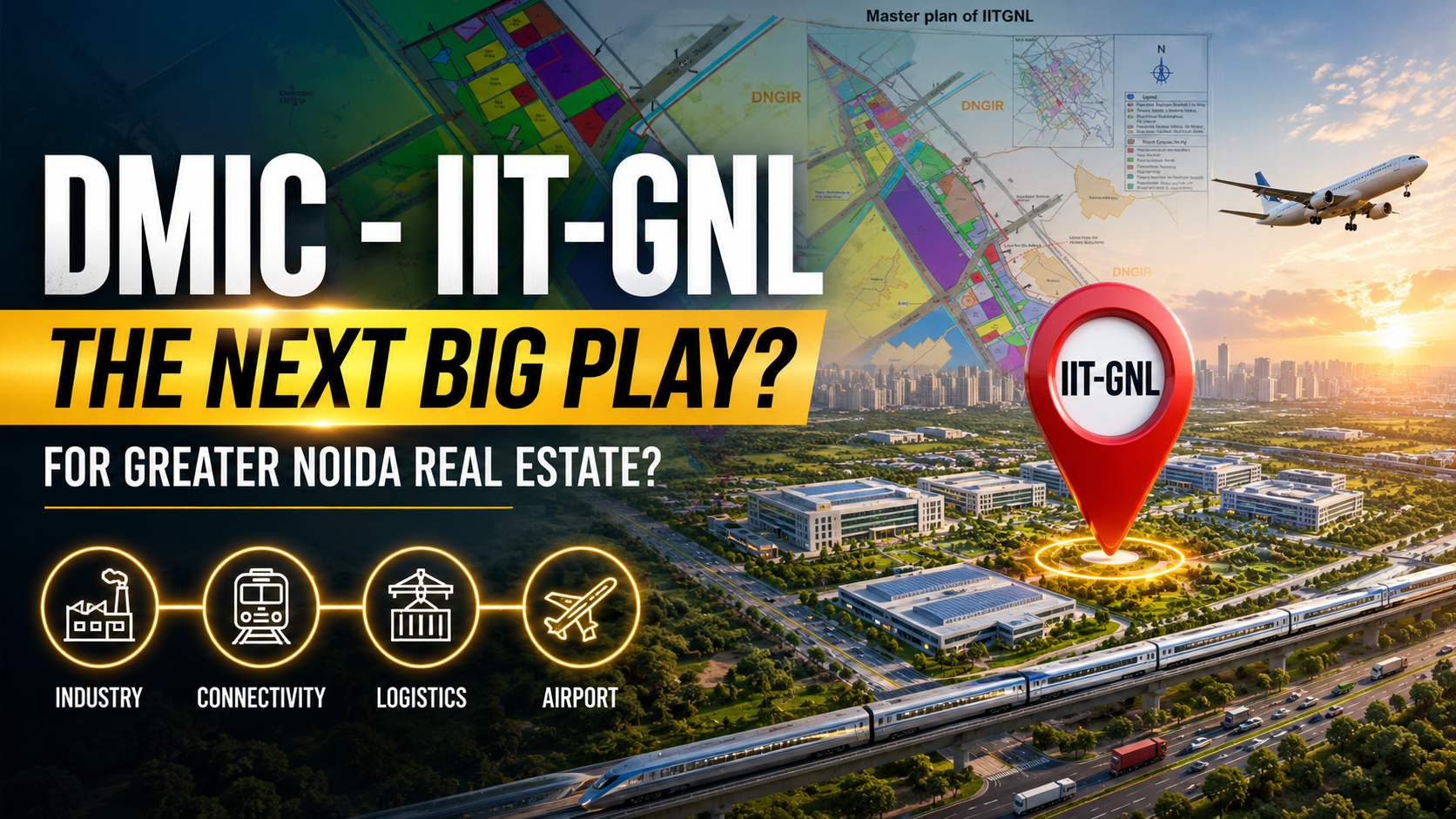
Today, when this project is poised to launch in Oct-Dec quarter 2026, we first try to break down what is DMIC, its significance, what is IIT-GNL and all of these in this blog.
We will go section by section and in case you feel that you are aware of the information presented in any section, you are welcome to skip to the next one.
So lets begin…
DMIC stands for Delhi-Mumbai Industrial Corridor. It is one of the most ambitious infrastructure and economic development programs of the Government of India, designed to establish futuristic smart industrial cities and position India as a premier global manufacturing and trading hub. It was conceived in 2006 as a symbol of strategic Indo-Japanese strategic partnership and approved by the cabinet in 2007. In simple words – multiple infrastructure developments to be carried out from Delhi to Mumbai, backed by a high capacity 1504 km long Western Dedicated Freight Corridor (WDFC).
Now to monitor such a big project, a central agency was formed, DMICDC (Delhi Mumbai Industrial Corridor Development Corporation Ltd) which was later re-branded to NICDC (National Industrial Corridor Development Corporation) to cater 10 other industrial corridors sanctioned by the GoI.

The purpose of this agency is to create integrated nodes across such industrial corridors to boost investments across the country.
How?
Let’s understand with the example of IIT-GNL
Whenever NICDC plans for a node along the corridor, it first creates a SPV (Special Purpose Vehicle) , a joint venture between NICDC itself and the state development authority. The core idea of these SPVs is to build properties around industrial corridors that provide plug and play utility framework.
Here in case of IIT-GNL (Integrated Industrial Township Greater Noida Limited), the JV is between NICDC and Greater Noida Authority. The Greater Noida Authority here provides the land for development and NICDC brings in investors and funds for the development of the node.
In simple terms, this SPV acts as a property manager. The property here is Integrated Industrial Township and SPV overlooks the development and maintenance of this property along with bringing in leasees. In IITGNL, as per NICDC website (at the time of writing), a total of 25 plots have been allotted totaling 258 Acres out of the 747 Acres township. The key investors are Forme, Hair Appliances, Satkriti Infotainment, Chenfeng, JWorld Electronics creating an investment potential of ₹6,482 Crores.
These investors are attracted based on the focussed sectors decided according to the strengths of the local region. For example the sectors in focus for IITGNL are Mobile Phones, White Goods and Electronics System Design Manufacturing in accordance with UP electronics policy.
Now what is the Plug and play framework here?
Every industrial plot is supplied with direct utility connection points at the property line, allowing corporate investors to construct facilities and commence operations without facing municipal delay or off-site infrastructure hurdles. Utility trunk lines—including high-voltage electricity, potable water, recycled water, natural gas, telecom fiber, and automated waste lines—are housed within underground utility ducts beneath surface roads, eliminating road trenching and overhead wiring.
Power infrastructure is anchored by a dedicated 220/33 kV electrical substation located within the township, supported by an automated 33/11 kV distribution grid. To protect high-precision electronics manufacturing and IT operations from voltage fluctuations, every plot is equipped with a dedicated Ring Main Unit (RMU) building.
Water systems operate under a Zero Liquid Discharge (ZLD) policy. The township maintains a potable water design capacity of 21.94 Million Liters per Day (MLD) backed by a 2,000 Kiloliter (KL) storage reservoir. Sewerage infrastructure handles 15.33 MLD, routing effluent to an onsite treatment plant that feeds a 7,000 KL recycled water reservoir for industrial cooling and landscaping re-use. Solid waste management is powered by an Automated Waste Collection System (AWCS) paired with an onsite Bio-Methanation plant designed to process 60.3 Tonnes per Day (TPD). Solid waste dropped into sealed inlet chutes is transported pneumatically through underground vacuum pipes directly to the processing plant, removing garbage trucks and open dumps from the urban landscape.
Now this is just one node we are talking about here. In the DMIC itself, there are other 8 nodes planned out of which Dholera Special investment Region is amongst one of them.

Now coming back to IIT GNL…
This township is built with the major focus to boost industries. So if we see the land bifurcation – 43.5% area is dedicated to industries followed by 41.6% for utilities and green spaces followed by 9.7% area for residential use. So one thing is clear for investors in the residential sector, that land will be scarce here and accordingly you can plan your investments.

For NICDC IIT-GNL is one of the flagship nodes in DMIC. Why? because it also intersects with the Dadri – Noida – Ghaziabad Investment Region (DNGIR) which is also commonly known as new Noida. This area is being planned to be the commercial capital of Uttar Pradesh because of 2 other hubs being planned in vicinity of IIT-GNL
First is the Multi-Modal Transport Hub (MMTH) covering 360 acres surrounding the existing Boraki (Bodaki) Railway Station along the main Delhi-Howrah rail line. Designed to handle long-term passenger growth across the DNGIR, the MMTH integrates regional, interstate, and intra-city passenger transit networks into a single terminal complex.
The MMTH framework combines an upgraded Boraki passenger rail terminal, an Inter-State Bus Terminal (ISBT) for long-distance routes, a Local Bus Terminal (LBT) for intra-city transit, and direct connections to Mass Rapid Transit System (MRTS) metro lines and proposed Regional Rapid Transit System (RRTS) corridors linking directly to Noida International Airport at Jewar one side and Central Delhi, Noida and Ghaziabad on other side.
The Other hub is Multi Modal Logistics Hub at Dadri. Spanning 825 to 849 acres, the MMLH is designed as a mega inland dry port to serve export-oriented industries across Western Uttar Pradesh and the broader NCR. The MMLH sits at the confluence of India’s two main Dedicated Freight Corridors: the Western DFC (connecting to JNPT, Mumbai) and the Eastern DFC (connecting Dadri to Dankuni, West Bengal). Located 5 km from the New Dadri DFC interchange yard, the MMLH enables manufacturing units operating in Northern India to load freight directly onto double-stacked rail container trains. By integrating container stacking yards, customs clearance facilities, bonded cold storage, and mechanical warehousing into a single Public-Private Partnership (PPP) facility, the MMLH streamlines export logistics. Container transit times to Western sea ports are reduced from 14 days by road to ~14 hours by rail, driving down overall freight costs for regional exporters.

So, What Does All of This Mean for Real Estate?
Till now, we have looked at IIT-GNL from an infrastructure and industrial perspective.
But for a real estate investor, what is more important is that when an industrial ecosystem of this scale starts attracting companies, capital and eventually people, what actually happens?
IIT-GNL itself has a very limited residential allocation — just 9.7% of the township’s total land use, while 43.5% is allocated to industrial development and another 41.6% to utilities and green spaces.
From the planning also it is evident that IIT GNL is primarily developed as an employment generating industrial ecosystem. And to cater that Godrej Properties has secured 23.2 Acres and Hero Realty 17 Acres of Land parcel in this township. From the initial numbers of these projects, it can be decoded that smaller size apartments will be preferred. We have covered this in our previous article.
The micro-markets that will be impacted by this township are by
- People working in this industrial township
- People looking for an upgrade from the older societies of Greater Noida
- People looking to settle in Greater Noida living in other locations of Noida
Moreover these developments will act as a gateway to the future planned DNGIR too however, the details for this region are yet to be released by the concerned authorities.
Until then….
(By Ramkrishna Agrawal)